
Mobile · Rancho Cucamonga & the Inland Empire
We remove the defects.
We don't hide them.
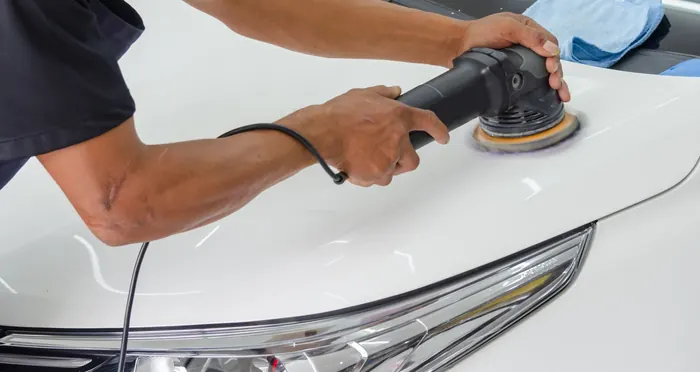
Machine polishing that levels swirls, scratches and oxidation out of your clear coat — measured first, so nothing gets polished past safe. Done at your home, finished with a six-month sealant.
Filling versus correcting
Plenty of "polishes" are really glazes. They fill swirls with oils and fillers that look fantastic in the driveway and wash out in three weeks, taking the result with them. That's why a car can look perfect leaving a shop and tired again by the following month.
Correction is different. It removes a measured amount of clear coat so the surface becomes level with the bottom of the defect. There is nothing to wash out, because nothing was filled — the scratch is gone. That's why the difference still holds up in direct sun months later.
What causes the damage in the first place
- Automatic tunnel washes. Spinning brushes drag grit across every panel. The single biggest source of swirls we see.
- Dirty towels and single-bucket washing. Grinding the dirt you just removed back into the paint.
- Inland Empire sun. UV oxidises clear coat until reds and blacks chalk out.
- Hard water. Minerals bake on and etch permanently if left through a summer.
- Rail dust and freeway fallout. Iron particles embed and rust from inside the surface.
Pricing
One step or two.
Ranges run sedan to large SUV or truck. A consultation comes first — we won't quote correction blind.
| Package | Improvement | Process | Time | Price |
|---|---|---|---|---|
| One Step | 50–70% | All-in-one compound and polish | 5 hours | $450–$550 |
| Two Step | 70–90% | Cut, then refine polish | 8 hours | $700–$850 |
Both include a six-month paint sealant across all painted and trim surfaces. If you want the result to last years rather than months, the correction pairs with a ceramic coating — the combined packages start at $1,100.
Which one do you need?
One step suits a car that looks dull and swirled under sunlight but has no deep marks — most daily drivers. It gets the majority of the way there for the majority of the price.
Two step is for paint with real defects, or for a car about to be coated where you want the finish as close to perfect as the clear coat safely allows. The cut stage removes the damage; the refine stage removes the haze the cut leaves behind.
Why we measure before we polish
Your clear coat is finite. It's typically somewhere between 40 and 60 microns — thinner than a sheet of paper — and every correction consumes a few of them. Once it's gone it does not come back, and the only fix is a repaint.
So the first thing that happens is a paint depth gauge, panel by panel. Those readings tell us how much material is actually there, whether a panel has been resprayed, and how aggressive we can safely be. A detailer who skips this step is guessing with something you can't replace.
Sometimes the honest answer is no. If the readings come back thin, we will tell you a panel can't take a two-step, or that it shouldn't be corrected at all. We would rather lose the upsell than burn through your clear coat.
What's correctable and what isn't
A useful test you can do yourself: run a fingernail lightly across the scratch.
- Your nail glides over it — it's in the clear coat. Correctable.
- Your nail catches — it's through the clear coat, into base or primer. Polishing cannot fix that. It needs paint.
Swirls, wash marring, light scratches, water spot etching and oxidation are all correctable. Rock chips, deep key scratches, and anything down to metal are not. Nobody can polish those out, and anyone who claims they can is either going to fill them temporarily or burn through your paint trying.
How the day runs
- Intake. We walk the car with you, note every defect and photograph the starting condition.
- Decontamination. Hand wash, iron removal, clay bar exfoliation — polishing over bonded contamination just grinds it in.
- Measurement. Paint depth readings, panel by panel, under inspection lighting.
- Correction. Machine polishing in stages, checking the finish under corrected light as we go.
- Protection. Six-month sealant on paint and trim.
- Handover. Before and after documentation, and a walk of the finished car with you.
All of it happens in your garage. Your car never leaves the driveway, and you can watch any part of it you want to.
Common questions
Will the swirls come back?
Not on their own — they were removed, not covered. But new ones can be inflicted by how the car is washed. Two-bucket hand washing with clean media keeps a correction looking corrected. Tunnel washes will undo it inside a few months.
Can you correct a leased car?
Yes, and it's often worth it before handback to avoid wear-and-tear charges. Worth checking your lease terms on paint work first.
Do you correct matte or satin paint?
No. Matte finishes must not be polished — it makes them glossy in patches and the damage is permanent. Matte paint needs its own products and process. Tell us at booking and we'll advise honestly rather than take the job.
Also available
The rest of the menu.
Find out what's actually under there.
Send photos through the booking form and we'll tell you straight.